
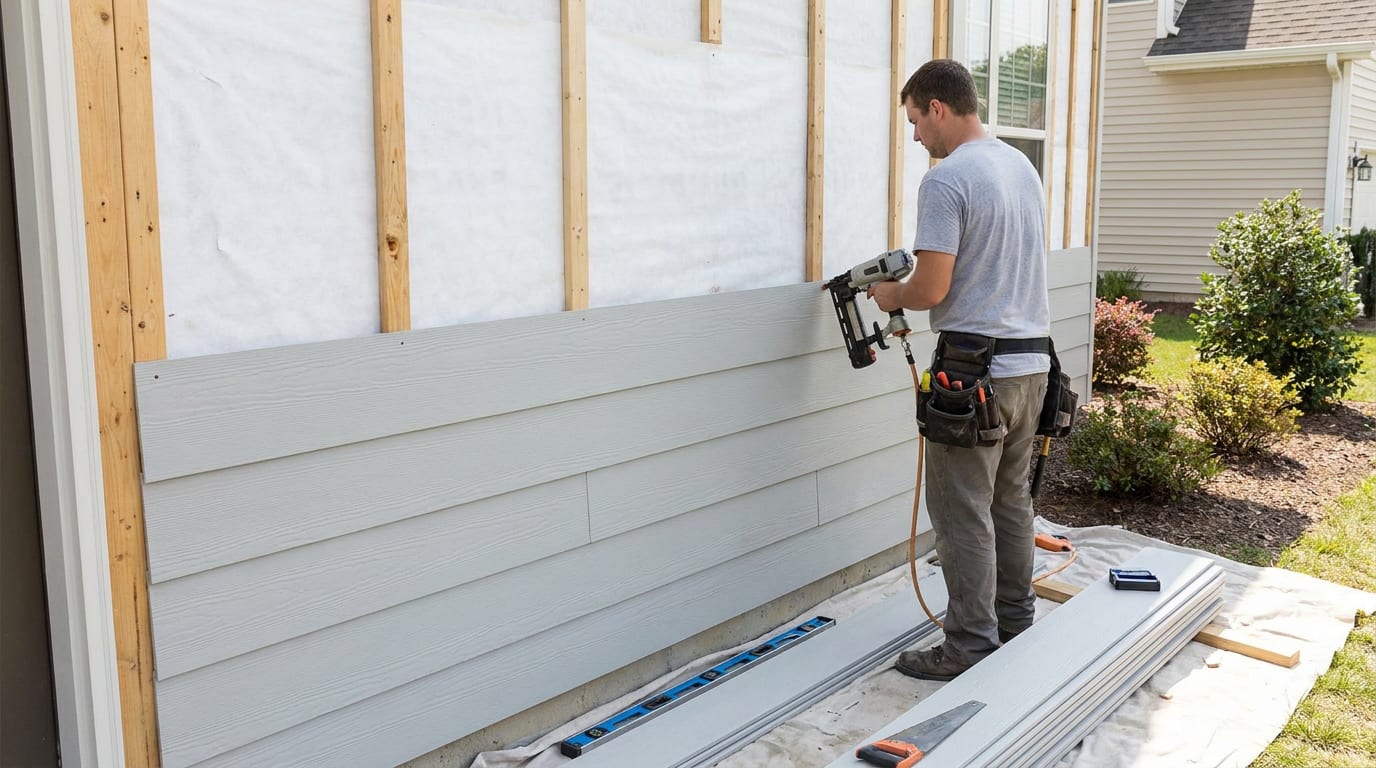
· by Michael Blair, Nashville's Siding
Fiber cement and vinyl are the two realistic choices for most Nashville re-sides. Both perform well here. The trade is a higher up-front cost and a repainting obligation against a lower cost and a material that is harder to make look like anything other than vinyl.
How do fiber cement and vinyl handle our climate?
Fiber cement is dimensionally stable in humidity, does not burn, and holds paint far longer than wood. It is heavy and brittle, which makes installation more demanding.
Vinyl expands and contracts substantially with temperature, which is why it is hung loosely rather than nailed tight. Face-nailed vinyl buckles in a Nashville August, and it is a common installation error.
The painting question
Factory-finished fiber cement carries long finish warranties and typically goes a decade or more before repainting. Field-painted fiber cement needs repainting on a similar cycle to wood.
Vinyl is colored through and never needs painting, but it fades — unevenly on elevations with different sun exposure — and it cannot be meaningfully refinished.
Damage and repair
Vinyl cracks in cold impact and melts near a barbecue or a reflected-sun window. Individual panels unzip and replace easily, which is a genuine advantage.
Fiber cement resists impact better but chips at edges, and matching a weathered painted finish on a patch is harder than swapping a vinyl panel.
- Fiber cement: stable, fire resistant, needs repainting eventually
- Vinyl: no painting, fades, easy panel replacement
- Both: performance depends heavily on installation quality
- Insulated vinyl narrows the appearance gap and adds a little R-value
Which siding costs more over time?
Fiber cement typically costs meaningfully more installed. Over twenty-five years, factoring one repaint, the gap narrows but does not close.
Where it clearly pays is resale perception in mid and upper Nashville brackets, where fiber cement reads as an upgrade and vinyl reads as builder-grade.
FAQ
Fiber Cement or Vinyl Siding in Nashville — questions
Does fiber cement siding need painting?
Factory-finished products come with a long finish warranty and often go fifteen years or more before repainting. Primed-only board painted on site behaves more like wood and needs repainting on a shorter cycle. The distinction matters a great deal to lifetime cost and is worth confirming in the quote.
Does vinyl siding melt in the sun?
Not from direct sun alone, but reflected and concentrated heat can distort it — most commonly from low-E window glass on a neighboring house focusing sunlight onto a wall, or from a grill placed too close. It is uncommon but real, and it is worth siting a grill with it in mind.
Can new siding go over old?
Vinyl is sometimes installed over existing siding, and it is generally a poor idea. It hides whatever condition the wall is in, prevents proper flashing and weather barrier installation, and means any rot behind continues unseen. Tear-off costs more and is the version that actually protects the house.
Is Hardie siding vinyl?
No. Hardie is fiber cement, a heavy, brittle board that stays stable in humidity, does not burn and gets painted, at the factory or on site. Vinyl is colored all the way through, never needs paint and is hung loose because it expands and contracts with temperature. The two install, age and repair differently.