
· by Michael Blair, Nashville's Siding
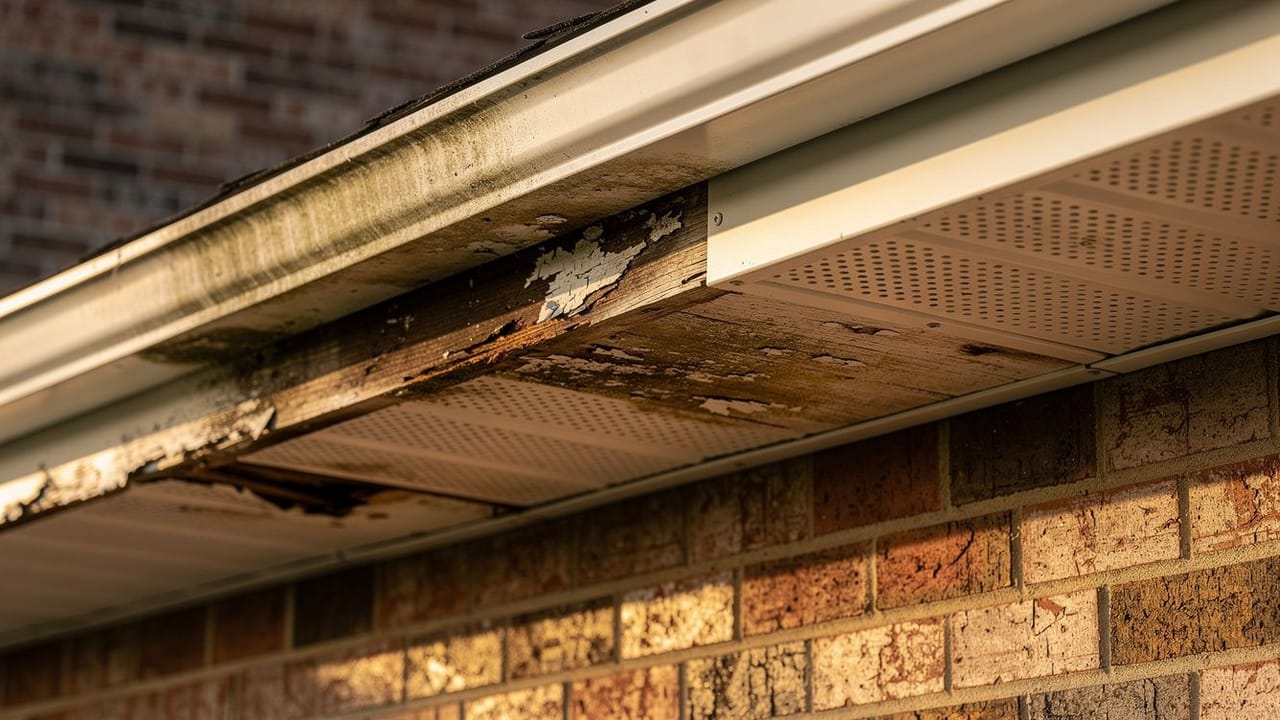
The soffit is the panel that closes the underside of the roof overhang, and on most Middle Tennessee houses it is also where the attic draws in its air. When one stains, sags or opens up, the soffit itself is rarely where the trouble started. Water from the roof edge, a squirrel or a wasp colony found the weak spot first, and a repair that swaps the panel without dealing with that comes back. Here is what does the damage, what the soffit has to keep doing for the attic, and how our trim, soffit and fascia work handles each material.
Water from the gutter and the roof edge
Most stained or soft soffit is wet from above. A gutter packed with oak leaves fills in a hard rain and spills over its back edge, between the gutter and the house, soaking the fascia board and running into the soffit behind it. NC State Extension’s carpenter ant guide says clogged gutters may lead to wood rot on fascia and soffits, and tells homeowners to keep gutters and downspouts clear so rainwater does not dam up and overflow. The guide is about ants for a reason: soft, wet wood at the eaves is what they move into.
A roof edge that leaks does the same thing from the other side. Water that gets past the last course of shingles reaches the top of the fascia and the ends of the rafters and works down into the soffit cavity, where nobody sees it until the paint blisters. The U.S. Department of Energy’s Guide to Durable Attics lists the signs together: warped or rotted wood soffit panels or the fascia board under them, bubbled paint at the fascia or soffits, worn or warped shingles at the roof edge, and wet attic insulation near the eaves.
Under a shaded eave in our humidity, wood that gets wet often never fully dries between rains, so the damage creeps along the board instead of staying where the water entered. When the staining carries on down the wall below, the siding may be hiding the same problem, which we cover in what is rotting behind your siding.
Squirrels, birds and wasps at the eave
A soft corner of soffit is an easy door into the attic. Squirrels chew through rotted boards at the eave, and birds nest in the gap a sagging panel leaves where it has dropped out of its channel. That is why the University of Missouri Extension’s tree squirrel guide puts repairing rotten boards along soffits and eaves on its list for keeping squirrels out. The hole is usually the second thing that happened; the rot came first.
Paper wasps use the same spaces. Penn State Extension on the European paper wasp says the nests are built under and within the eaves, in attics and in wall voids, and that prevention means caulking cracks in soffits and eaves and screening vents and louvers. A colony living inside the soffit cavity is treated at the openings first, which Penn State describes as insecticidal dust at the void openings, before any panel comes down.
The vents themselves are part of keeping animals out. Section R806.1 of the 2018 International Residential Code as Tennessee adopted it calls for ventilation openings no smaller than 1/16 inch and no larger than 1/4 inch, with anything larger screened, protected against birds, rodents, snakes and similar creatures. A torn screen or an opening cut wider for more air trades one problem for another.
What the soffit does for the attic
Vented soffit is the attic’s intake. The DOE’s Guide to Durable Attics says vented soffit panels let air enter beneath the roof overhang and work best paired with a ridge vent, and it warns that improper attic ventilation lets moisture build up, which can cause mold, ruin insulation and damage wood. A soffit repair that swaps vented panels for solid ones, or paints the vents shut, quietly takes that intake away.
The amount of venting is set by Section R806.2 of the same 2018 code: net free ventilating area of 1/150 of the vented space. It may drop to 1/300 when 40 to 50 percent of the required area sits in upper vents within 3 feet of the ridge and the rest is in the bottom third of the attic, with a vapor retarder also required in climate zones 6, 7 and 8. On most houses here, the soffit vents are that bottom third. Metro Nashville has since adopted the 2024 edition, per the Metro Codes adopted codes list, so the permit office confirms the current section numbers.
Open vents do nothing if insulation is packed against them. R806.3 requires at least a 1-inch space between insulation and the roof sheathing at an eave vent, and the DOE’s building science page on baffles describes a baffle that keeps a 2-inch air gap under the roof deck, guides air from the soffit vents toward the ridge vent, and goes in every rafter bay that has a soffit vent. When a soffit is open for repair is the easiest time to look up into those bays and set baffles where they are missing.
Repairing each kind of soffit, and when the fascia goes too
Vinyl and aluminum soffit are panel systems that slide into channels at the wall and at the fascia, so a damaged run is usually replaced panel by panel. Sagging vinyl is most often an installation problem. The Polymeric Exterior Products Association’s soffit installation guide calls for nailing the channels every 8 to 12 inches in the center of the slot without nailing tight, adding nailing strips where the eave spans more than 16 inches, and cutting panels 1/2 inch short of the wall-to-fascia measurement so they can expand.
Wood soffit is cut back to sound wood and replaced with new boards primed on every face, including the cut ends, and the lookouts the boards fasten to are checked while the run is open. Fiber-cement soffit does not rot, but the wood it hangs from can, so a cracked or loose section is a reason to check what is behind it.
The fascia is where the soffit and the gutter both hang. If it is soft where the gutter fastens or where the outer edge of the soffit meets it, a new panel is being nailed to failing wood, and the fascia comes off with it so the rafter tails can be checked and the gutter rehung on solid board. Bending aluminum over rotted fascia only hides it. If you have a stained, sagging or open soffit, ask for a free estimate and we will look at the gutter, the roof edge and the attic side along with the panel.
- Vinyl: replace the damaged panels, renail loose channels without nailing tight, add support on long spans
- Aluminum: replace dented panels rather than straightening them
- Wood: cut back to sound wood, new boards primed on all faces, lookouts checked
- Fiber cement: replace the cracked section and check the framing it fastens to
Sources
- International Residential Code 2018 (Tennessee), Chapter 8, R806 Roof Ventilation — Vent opening size and protection (R806.1), the 1/150 and 1/300 ratios (R806.2), insulation clearance at eave vents (R806.3)
- Metro Nashville Codes, Adopted Codes List — Metro Nashville has adopted the 2024 International Residential Code
- U.S. Department of Energy, Guide to Durable Attics (DOE/EE-0339, 2010) — Signs of water intrusion at soffit and fascia; vented soffit paired with a ridge vent; effects of poor ventilation
- U.S. DOE Building Science Education, Baffles — Baffles keep a 2-inch air gap and go in every rafter bay with a soffit vent
- NC State Extension, Biology and Control of Carpenter Ants — Clogged gutters lead to wood rot on fascia and soffits
- University of Missouri Extension G9455, Tree Squirrels — Repair rotten boards along soffits and eaves to keep squirrels out
- Penn State Extension, European Paper Wasp — Nests under and within eaves; caulk soffit cracks, screen vents; dust treatment at void openings
- Polymeric Exterior Products Association, Soffit Installation Guide — Nailing spacing, nailing strips over 16 inches, 1/2-inch expansion allowance