
· by Michael Blair, Nashville's Siding
The question comes up every fall: can new siding go on now, or should it wait for spring? Vinyl can be hung in the cold. What changes is how much room each panel is given at the corners and trim, how it is cut, and how carefully each nail is set, because a panel cut and fitted on a cold morning is at its shortest and will grow once the sun is on it. This is what the industry manual and one manufacturer ask for, and how we handle winter work on vinyl siding installations.
Why does vinyl siding need room to move?
Because vinyl changes length as its temperature changes, and every gap and nailing slot on the wall is there to let it. Gentek’s vinyl products installation guide, published for the Canadian market, puts the movement at about 1/3 inch in a 10-foot length over a temperature change of 131 °F, and says its nailing slots and nailing instructions are designed around that.
The industry manual turns the movement into numbers. The Polymeric Exterior Products Association’s installation manual for horizontal siding asks for a 1/4-inch gap between the siding and every corner post and channel. It also says not to drive a nail head tight against the nailing slot: leave about 1/32 inch between the head and the vinyl, roughly the thickness of a dime, and do not force panels up or down while fastening them.
How cold is too cold to hang vinyl siding?
Neither the industry manual nor the manufacturer we read sets a temperature below which vinyl cannot go on. They widen the gaps instead, and they draw the line in different places.
The PEPA manual increases the 1/4-inch gap at corner posts and channels to 3/8 inch when installing in temperatures below 40 °F, and for panels 20 feet or longer it sends installers to the manufacturer for how much more to allow. Gentek’s guide keeps 1/4 inch where panels fit into accessories, but when the temperature is below freezing at the time of application it raises the minimum clearance to 1/2 inch. Two sources, two thresholds and two gaps: the siding on the truck decides which one applies, so we read its maker’s sheet before the first cut.
The reason for the wider gap in the cold is simple arithmetic. A panel cut to fit on a cold morning is close to the shortest it will ever be, and every degree it warms after that it gets longer. Insulated siding follows the same logic. The PEPA manual says no gap is needed between the foam at the panel ends when they overlap, unless the siding is going on in cold weather, in which case the manufacturer’s instructions govern.
Winter in Middle Tennessee against the 40-degree line
Nashville’s normal low is below 40 °F in every month from November through February. The National Weather Service’s Nashville climate records page lists normal lows of 39.2 °F in November, 33.3 °F in December, 30.1 °F in January and 33.0 °F in February, against normal highs of 61.4, 52.2, 49.1 and 53.8 °F.
So a typical winter siding day here starts below the manual’s 40-degree line and often finishes above it, and from December through February the normal low sits within a few degrees of freezing, where Gentek’s larger clearance comes in. We set the gap for the temperature when each panel is cut and fitted, not for the afternoon high, and on a winter morning start that means the cold-weather gap. That is the opposite problem from the one in our post on vinyl siding that warps or melts in one spot, where the trouble comes from heat.
Cutting and nailing on a cold day
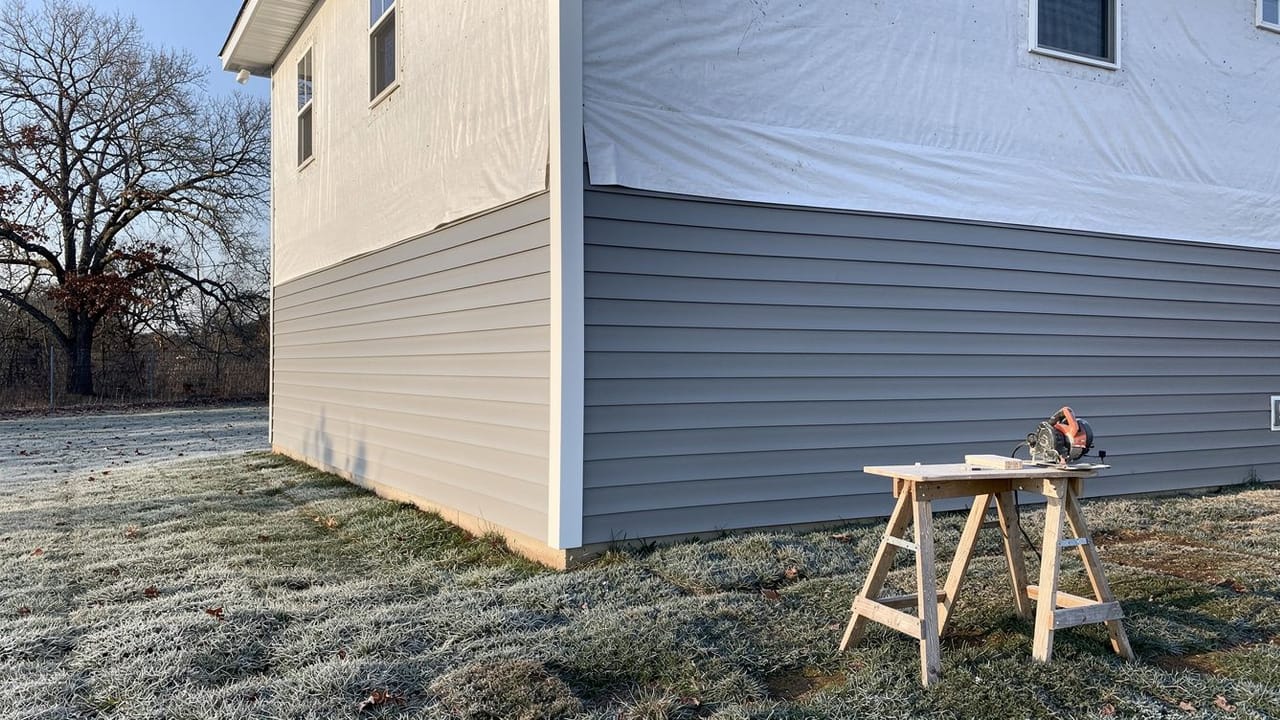
Cold vinyl is cut slowly. PEPA’s installation tips say that with a circular saw, the fine-toothed blade goes on backwards and the cut is made slowly, especially in cold weather. The same page puts each nail in the center of the slot with about 1/32 inch of clearance under the head, keeps panels free to slide from side to side, and rules out face nailing except for a single nail at the top of a gable.
Fasteners still have to hold. The manual asks for nails long enough to reach at least 1 1/4 inches into nailable material, framing or sheathing and framing together. A panel nailed tight, or jammed hard against a corner post on a cold morning, has nowhere to go when it warms, and that is exactly what the gaps and the loose nailing are there to prevent.
If you are still weighing materials, our comparison of fiber cement and vinyl for Nashville houses covers that choice. For a winter re-side in Nashville or nearby, tell us about the house and we will send a written estimate.
Sources
- Polymeric Exterior Products Association, Installation Manual: Horizontal Siding — 1/4 inch gap at corner posts and channels, 3/8 inch below 40 °F; about 1/32 inch under the nail head; 1 1/4 inch penetration; insulated siding in cold weather
- Polymeric Exterior Products Association, Vinyl Siding Installation Tips and Tricks — Nails centered in the slot with 1/32 inch clearance; panels free to move; no face nailing; cut slowly with a reversed fine-toothed blade, especially in cold weather
- Gentek, Vinyl Products Installation Guide (Canada) — About 1/3 inch of movement in 10 feet over 131 °F; 1/4 inch clearance at accessories, 1/2 inch when below freezing at application
- National Weather Service Nashville, Nashville Climate Records — Monthly normal highs and lows for Nashville: lows below 40 °F from November through February
FAQ
Can Vinyl Siding Go On in Winter? — questions
Can vinyl siding be installed in cold weather?
Yes. The industry installation manual does not stop work in the cold; it widens the gap at corner posts and channels from 1/4 inch to 3/8 inch below 40 °F. Gentek, one manufacturer, asks for 1/2 inch at accessories below freezing. Cuts are made slowly, and the siding maker’s own instructions decide the details.
What temperature is too cold to install vinyl siding?
The sources we use set no cutoff. They change the clearance instead: the industry manual at 40 °F, Gentek at freezing. What goes wrong in the cold is a crew working the way it does in summer, cutting fast and fitting panels tight to the trim with no allowance for each panel lengthening as it warms.
How tight should vinyl siding nails be?
Not tight. Each nail goes in the center of the slot, and the head stops about 1/32 inch off the vinyl, roughly a dime’s thickness, so the panel can slide side to side. The industry manual also asks for at least 1 1/4 inches of penetration into nailable material such as sheathing and framing.
Why does vinyl siding need gaps at the corners?
Vinyl changes length with temperature, about 1/3 inch over a 10-foot length across a 131 °F swing by Gentek’s figure. The gap at corner posts and channels, 1/4 inch normally and 3/8 inch below 40 °F under the industry manual, gives each panel room to grow without pushing against the trim.
Does vinyl siding crack when it is installed in the cold?
The installation sources we rely on give no cracking rates. What they do say is to cut slowly in cold weather, with a fine-toothed blade turned backwards on a circular saw, and to allow wider gaps at the trim. We handle cold panels gently and keep the cutting pace slow and steady on winter mornings.