
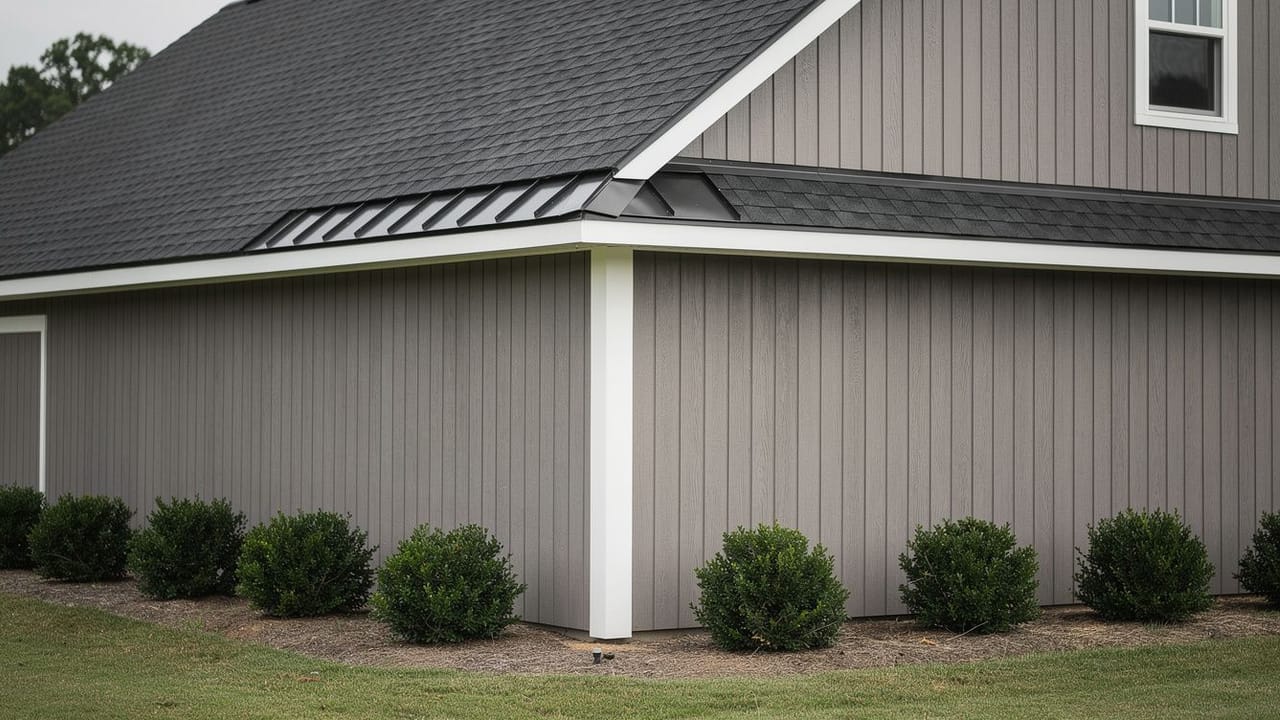
· by Michael Blair, Nashville's Siding
Artisan is James Hardie’s lock-joint line of fiber-cement siding, and V-groove is the profile in it that leaves a V-shaped groove where each plank meets the next. It is installed differently from the lap siding most crews hang every week, and those differences decide whether the grooves stay crisp and the joints stay closed. What follows comes from James Hardie’s Artisan lock-joint installation requirements and the residential code’s siding section, and it is how we approach it on our fiber cement installations.
What makes Artisan V-groove different from ordinary lap siding?
Each plank locks into the course below it instead of simply lapping over it. James Hardie’s Artisan Siding with Lock Joint System installation requirements cover four profiles on that system, V-Groove, Square Channel, Bevel Channel and Shiplap, and all four can go on horizontally, vertically or as soffit. Because the joint sets the spacing, a starter strip is not needed and one person can stack a course onto the one below without a lap gauge.
The edition we read is dated July 2018, and the document itself sends installers to James Hardie for the latest version. The maker’s current instructions govern any job, so treat the numbers below as the shape of the rules and check them against what James Hardie publishes today.
The wall behind it matters more than with lap siding. The requirements call for studs no more than 24 inches on center or a minimum of 7/16-inch OSB, and they warn that irregularities in the framing and sheathing can show through. A long, straight groove is unforgiving of a wavy wall.
How are the butt joints handled on Artisan siding?
Butt joints must land at least 4 inches away from a stud, and each one is either caulked or flashed. Under the first option the plank ends meet with a gap set by the caulk maker’s instructions and the joint is caulked. Under the second, at least 3 inches of the locking lip comes off both plank ends and joint flashing goes behind them. No nail goes within 2 inches of a plank end either way.
Nailing follows the lock. Blind nails go 1 inch down from the top of the plank, face nails 2 inches up from the bottom, at no more than 24 inches apart. The residential code’s fiber-cement section, R703.10.2 in both the Tennessee Residential Code, 2018 edition and the 2024 Nashville edition, points the same way for lap siding: ends without tongue-and-groove joints are caulked, covered with an H-section joint cover or set over flashing, and fasteners can follow the approved maker’s instructions. Metro has enforced the 2024 edition for applications submitted after July 16, 2025, according to its announcement of the 2024 code adoption.
Can Artisan siding be installed vertically?
Yes, but it cannot run past a floor line. Vertical Artisan stops at each floor, and the horizontal joint between floors gets z-flashing. Within a floor there are no horizontal butt joints between planks, so each piece runs full length for that story, and a bead of sealant goes into each groove of the lock joint.
On a gable or an accent wall, one story-height run may cover the whole area. On a two-story wall it means planning the flashing line before the first plank goes up, the same kind of detail our post on the siding details that decide everything is about.
Where Artisan does not go, and how it is stored and cut
Artisan is not used for fascia or trim, so corner boards, window casings and fascia come from trim products, which is the work our trim, soffit and fascia service covers. The requirements also rule out stain, oil or alkyd paint and powder coating on it; our post on painting Hardie siding covers what does go on.
Behind it, a water-resistive barrier is required by local code, and James Hardie recommends a rainscreen air gap as best practice, which our post on fiber cement over a rainscreen gap goes into. The ground next to the wall should slope away, typically at least 6 inches over the first 10 feet.
The planks are stored flat, dry and covered, since wet siding can shrink at the joints after it goes up. They are cut outside, best with a fiber-cement saw blade and vacuum dust collection, and the dust is never dry-swept. If you are weighing Artisan for a house in Nashville or nearby, send us photos of the walls you have in mind, and we will tell you how the joints and floor lines would fall.
Sources
- James Hardie: Artisan Siding with Lock Joint System, Single Family Installation Requirements (July 2018 edition, Florida Building Commission product approval file) — Profiles and applications, substrate, no starter strip, butt joint options, nailing, vertical runs by floor, no trim or fascia, no stain or alkyd, water-resistive barrier and rainscreen, grade, storage and cutting.
- Tennessee Residential Code, 2018 IRC edition, Chapter 7 Wall Covering (UpCodes) — R703.10.2 fiber-cement lap siding: end joints caulked, H-section covered or over flashing; fasteners per the approved maker’s instructions.
- 2024 International Residential Code, Nashville edition, Chapter 7 Wall Covering (UpCodes) — The same R703.10.2 text in the edition Metro enforces.
- Metro Nashville Codes: Metro Adopts 2024 International Building Codes — The 2024 codes apply to applications submitted after July 16, 2025.
FAQ
Hardie Artisan V-Groove and How It Goes On — questions
What is Hardie Artisan V-groove siding?
It is a profile in James Hardie’s Artisan line of fiber-cement siding, with a lock joint that fits each plank into the one below and a V-shaped groove along each joint. It can be installed horizontally, vertically or as soffit, and it is installed differently from ordinary lap siding.
Does Artisan siding need a starter strip?
Not according to James Hardie’s Artisan lock-joint installation requirements. The lock joint sets the spacing, so the planks stack onto the course below without a starter strip or a lap gauge. The wall still needs flat framing or sheathing, because irregularities underneath can show through the long, straight grooves.
Can you stain Artisan siding?
No. James Hardie’s installation requirements for Artisan rule out stain, oil or alkyd paint and powder coating. Artisan takes paint made for fiber cement instead. If you want a wood-toned look, ask about a paint color or a different product rather than planning on stain.
Can Artisan siding be used for trim or fascia?
No. The installation requirements say Artisan siding is not to be used in fascia or trim applications. Corner boards, window and door casings and fascia are made from trim products instead, and the siding runs up to them. Plan the trim and the siding together so the joints meet cleanly.
Can Artisan siding be used as soffit?
Yes. James Hardie lists horizontal, vertical and soffit applications for its Artisan lock-joint profiles, including V-groove. A V-groove soffit can carry the same look as the walls under a porch or an overhang. Check the maker’s current instructions for the soffit fastening and support details before it goes up.