
· by Michael Blair, Nashville's Siding
Many houses that come up for siding replacement were built before 1978, and some still have their original painted wood siding, either exposed and peeling or hidden under aluminum or vinyl added later. On any house that old, the paint is assumed to contain lead until a test says otherwise, and a federal rule decides how the paint may be disturbed. Here is what the Environmental Protection Agency’s Renovation, Repair and Painting rule requires on the outside of a house, what it bans, and where testing changes the job.
Does the EPA lead rule apply to siding work?
The EPA lead rule applies to siding work on any house built before 1978 when the work disturbs paint. The EPA’s Renovation, Repair and Painting page for contractors says the rule reaches houses, apartments and child-occupied facilities from before that year, and that any activity disturbing the paint is covered, whatever the trade calls it. Scraping, sanding, cutting out boards and tearing siding off all count.
There is a small exemption for minor repair: 20 square feet or less of paint disturbed on the exterior, or six square feet or less in a room inside. It does not help with a siding job. The EPA page says demolition of painted surfaces is always covered regardless of square footage, and the definition in 40 CFR 745.83 takes the exemption away from any job that demolishes painted surface area or uses a banned practice. Pulling old painted siding off a wall is demolition of a painted surface. The EPA page also says a firm may not advertise or perform covered work without being certified, so ask any contractor for the firm certificate before the job is scheduled.
Can you paint over lead-based paint on siding?
You can paint over lead-based paint on siding, but the preparation is where the rule bites. Fresh paint on a sound surface does not disturb the old coat, while scraping loose paint and sanding the edges does, and that preparation is covered work. On a house built before 1978, almost every repaint of wood siding involves some of it.
Some methods are banned outright, no matter how small the area. The work practices in 40 CFR 745.85 prohibit burning or torching painted surfaces with an open flame. They prohibit sanding, grinding, power planing, needle guns, abrasive blasting and sandblasting on painted surfaces unless the machine has a shroud or containment system and a HEPA vacuum attachment. A heat gun is allowed only below 1,100°F. A disc sander and a propane torch, the quickest ways to strip a wall, are exactly what these limits are aimed at.
Does testing the paint change what the lead rule requires?
Testing the paint changes everything if it shows no lead, and nothing if it is skipped. The EPA page says testing is not required, but without documentation that the paint is not lead-based, the rule’s requirements apply. Paint can be tested with an EPA-recognized test kit, with an X-ray fluorescence analyzer, or by sending paint chips to a lab.
Newer siding over old paint does not settle the question either. An EPA answer kept in the agency’s January 2021 web archive takes the case of siding installed after 1978 but nailed over older lead paint on a pre-1978 house. Its answer is that scraping and repainting that siding is still covered, unless a trained, certified person tests the surfaces being disturbed, finds no lead-based paint and documents it. Vinyl or aluminum on the wall is not proof of anything about the paint underneath.
How the outside of the house is set up for lead-safe work
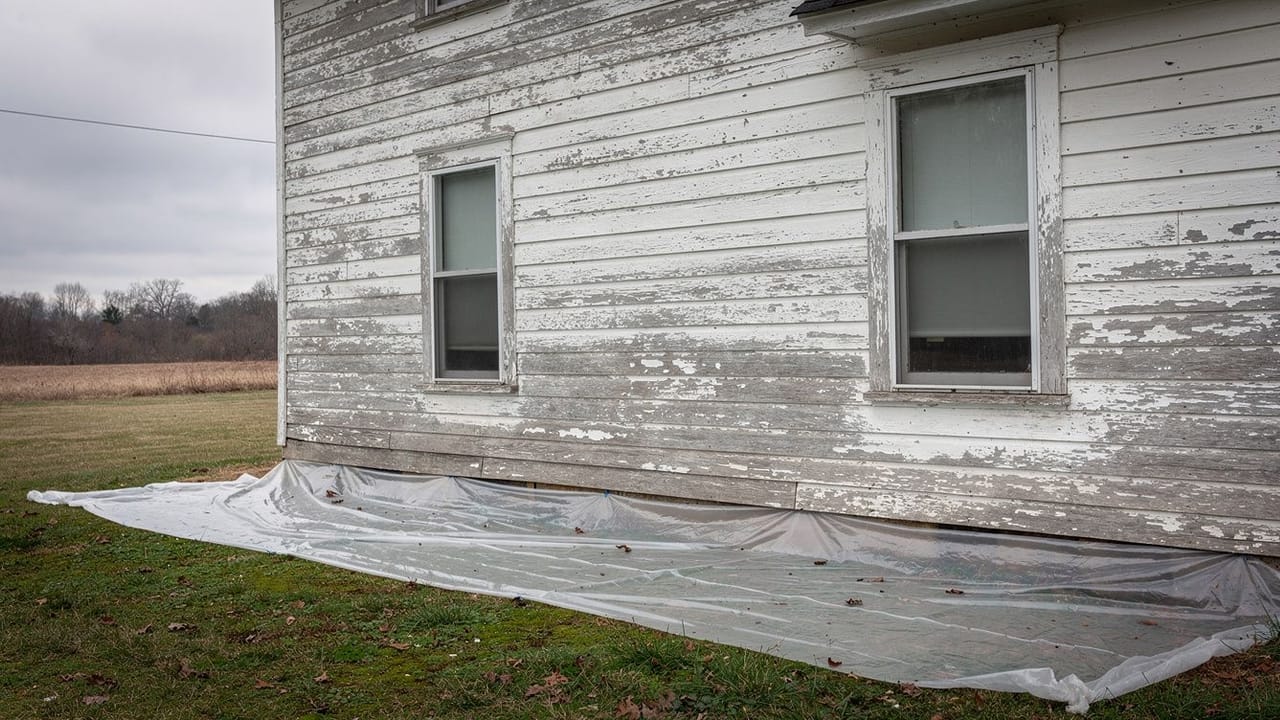
Exterior containment under 745.85 starts before any paint is touched. Doors and windows within 20 feet of the work are closed. Plastic sheeting covers the ground at least 10 feet out from the wall being worked on, or farther if that is what it takes to catch falling debris, unless the property line is closer than 10 feet. When the work is within 10 feet of the property line, the rule adds vertical containment so chips and dust do not land in the neighbor’s yard.
Where houses sit close together, as they do on many older city lots, that last condition comes up often. It is one reason a pre-1978 siding job takes longer to set up than the same job on a newer house.
Whether the old siding comes off or new siding goes over a repaired wall is a separate decision, and our post on when siding is actually due for replacement covers it. If your house in Nashville or nearby was built before 1978 and the siding needs work, send us the year it was built and a few photos, and we will tell you what the rule means for that wall before any paint is disturbed.
Sources
- U.S. EPA, Renovation, Repair and Painting Program: Contractors — Covers paint-disturbing work in pre-1978 housing; window replacement and demolition of painted surfaces always covered; minor repair is 20 square feet or less outside; firms must be certified; paint presumed lead-based without documentation
- eCFR, 40 CFR 745.85, Work practice standards — Bans open-flame burning and unshrouded high-speed removal machines; heat guns below 1,100°F; exterior containment: openings within 20 feet closed, ground sheeting 10 feet out, vertical containment near the property line
- eCFR, 40 CFR 745.83, Definitions (minor repair and maintenance) — The minor repair exemption does not apply to window replacement, demolition of painted surface areas, or prohibited practices
- U.S. EPA RRP question and answer on siding over old paint (January 2021 archive) — Scraping and repainting post-1978 siding nailed over lead paint on a pre-1978 home is covered unless a certified person documents that no lead-based paint is present
FAQ
Removing Old Siding With Lead Paint on It — questions
Is it legal to sand lead paint off house siding?
Only with a sander, grinder or planer fitted with a shroud or containment system and a HEPA vacuum attachment. The federal work practices in 40 CFR 745.85 ban those machines on painted surfaces otherwise, and they ban open-flame torching outright. Heat guns are allowed only at temperatures below 1,100°F, with the ground covered in plastic.
Is vinyl siding over old paint exempt from the lead rule?
No. An EPA answer about siding installed after 1978 over older lead paint says work that disturbs it on a pre-1978 house is still covered by the Renovation, Repair and Painting rule. The exception is when a trained, certified person tests the surfaces, finds no lead-based paint and documents the result.
How much exterior paint can be disturbed without following the lead rule?
Twenty square feet or less on the outside of a pre-1978 house falls under the EPA’s minor repair exemption. The exemption does not apply to window replacement, to demolishing painted surfaces such as tearing off siding, or to any job that uses a banned practice like torching or unshrouded power sanding.
Does a house built before 1978 have to be tested for lead before siding work?
Testing is not required. Without documentation that the paint is not lead-based, though, the EPA rule treats it as if it were, and every requirement applies. A certified renovator can test with an EPA-recognized kit, or the paint can be checked by X-ray fluorescence or by lab analysis of paint chips.