
· by Michael Blair, Nashville's Siding
Wood siding that has rotted in a few places does not usually need a whole new wall. It needs the decayed boards found, cut out and replaced, and the reason they rotted dealt with, so the new boards do not follow the old ones.
This is how we approach a wood siding repair: how we find the bad boards, why we replace rather than patch them, and the details at the ends and edges that decide how long the new wood lasts. Most of it comes from the USDA Forest Products Laboratory, whose Wood Handbook is the standard reference on how wood behaves outdoors.
How do you tell rotted siding from tired paint?
Rotted siding is soft under a probe, while tired paint only peels and chalks over sound wood. The Wood Handbook from the USDA Forest Products Laboratory warns in its finishing chapter that the surface can look sound when it is not, and says to probe several areas with a small-tipped screwdriver. We do that along the bottom courses, under windowsills, at the ends of boards beside trim, and anywhere a gutter or roof drops water onto the wall.
Insects are a clue too. The same chapter notes that carpenter ants do not eat wood but tunnel into moist or decayed areas, so their sawdust points to wet wood, and woodpecker holes often mean insects are in the wall. Our post on woodpecker and insect damage covers that side of it.
Can rotted wood siding be patched instead of replaced?
A board with decay in it gets replaced, not patched, because the Wood Handbook’s advice for siding is to replace decayed boards. The handbook also notes there is no known way to judge how much strength decayed wood has lost from its appearance, so a filled board is a guess about what is left inside it.
Replacing the board is only half the repair. The handbook says decay cannot start or progress if wood is kept below 20 percent moisture content, so rot means water has been reaching that spot. Before a new board goes up we find the source, which is often behind the siding rather than on it, as our post on what rots behind siding explains. On a house built before 1978, cutting out painted boards also brings in the EPA lead rule.
What does a new board need before it goes up?
A new board needs every cut end sealed before it is nailed up. The Wood Handbook says liquid water can enter end grain about 100 times faster than through the sides of a board, calls sealing end grain probably the single most valuable improvement in standard construction, and points out that end grain is often impossible to reach after assembly. Its preferred sealers are thin, solvent-based products that soak deep; where those will not do, a water-based primer still plugs the pores and slows water down.
Fasteners matter for the look of the repair. The handbook explains that iron from plain steel nails reacts with the tannins in woods such as western redcedar and redwood and leaves a black stain once the wood is damp. It treats stainless steel as safe from that stain and high-quality hot-dip galvanized nails as far less likely to cause it, and its photo of the problem is new cedar siding stained by cheap galvanized nails. So we match the nail to the wood.
Once the board is up, the repair is primed and painted to match. Paint, the handbook says, only slows water and does not stop it, which is why the end sealing comes first.
Where does wood siding rot first?
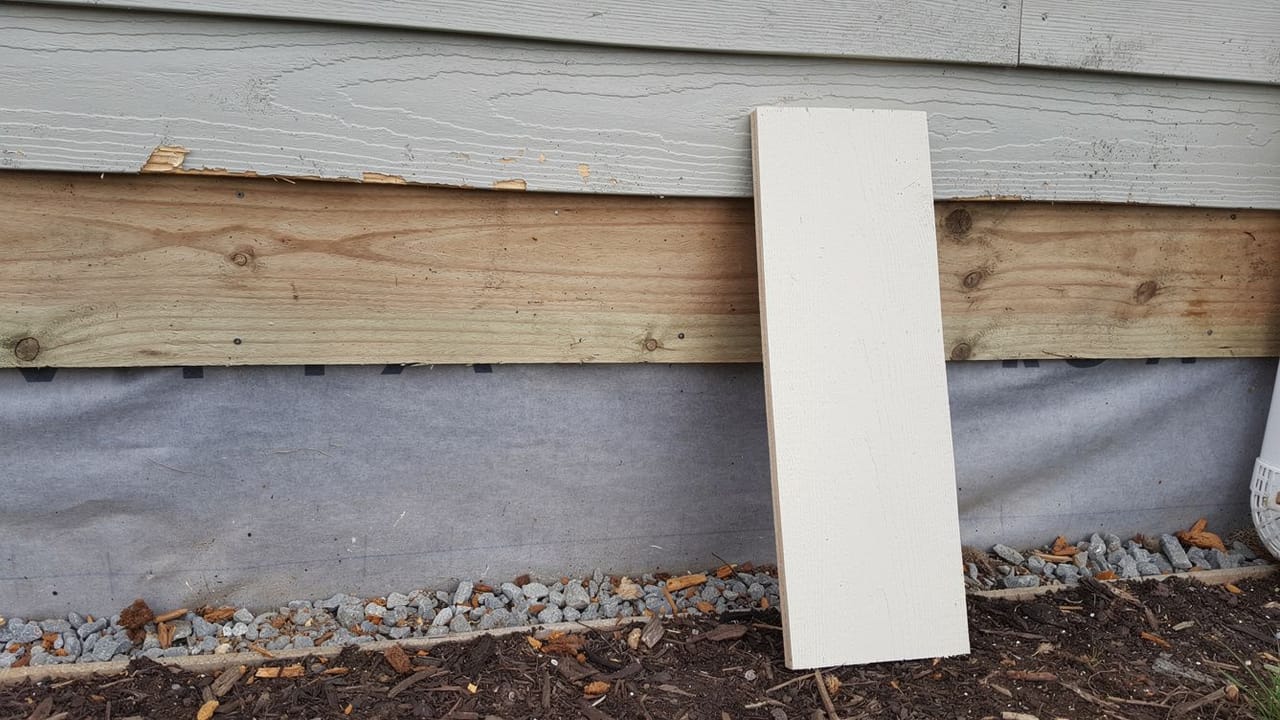
Wood siding rots first at its bottom edges, wherever they sit close to something that stays wet. The 2024 International Residential Code as adopted by Nashville, section R304.1, requires naturally durable or preservative-treated wood where siding is less than 6 inches above the ground or less than 2 inches above a porch slab, patio, step or similar surface. Mulch beds and settled soil creep up a wall over the years, so siding that cleared the ground when it went on may not any more.
The Wood Handbook adds two gaps of its own: 3/8 to 1/2 inch between siding and the flashing below it so the bottom edge drains, and about 2 inches where siding meets a sloping roof. When we replace a board near any of those, we restore the gap and seal the exposed end.
If you have soft boards on a wall, whether in Nashville or out in Franklin, tell us where they are and what is above them, and we will look at the wall and the water together.
Sources
- USDA Forest Products Laboratory, Wood Handbook (FPL-GTR-282, 2021) — Chapter 16 on probing for decay, replacing decayed boards, sealing end grain and drainage gaps; chapter 16 on iron stain from fasteners; chapter 5 on the 20 percent moisture threshold and judging decayed wood.
- 2024 International Residential Code as adopted by Nashville, Section R304.1 — Clearance of wood siding from the ground and from slabs, steps and patios.
FAQ
Repairing Rotted Wood Siding, Board by Board — questions
How do I know if my wood siding is rotten?
Press a small screwdriver into it. The USDA Wood Handbook warns that decayed wood can look sound under its paint, so probing is the test. Check the bottom courses, under windowsills, board ends beside trim, and anywhere roof or gutter water lands on the wall. Soft or crumbling wood means decay.
Can you replace just one piece of wood siding?
Yes. A single decayed board can be cut out and replaced without disturbing the wall around it, as long as the new board matches the profile and its cut ends are sealed before it goes up. The repair only holds if the water that rotted the old board has been stopped first.
What nails should be used on wood siding?
Stainless steel, or high-quality hot-dip galvanized where stainless is not used. The USDA Wood Handbook explains that iron from plain steel nails reacts with tannins in cedar and redwood and leaves black stains once the wood is damp. It treats stainless as safe from that and good hot-dip galvanized as far less likely to stain.
How far should wood siding be from the ground?
At least 6 inches from soil and 2 inches from a slab, step or patio, under section R304.1 of the 2024 residential code Nashville adopted, unless the wood is naturally durable or preservative-treated. Mulch and settled soil rise over time, so the gap a wall started with often needs restoring during a repair.
Why do you seal the ends of new siding boards?
Because end grain takes in liquid water about 100 times faster than the face of a board, according to the USDA Wood Handbook, which calls sealing it probably the most valuable improvement in standard construction. Once a board is nailed up its ends are hidden, so they have to be sealed first.