
· by Michael Blair, Nashville's Siding
Two quotes for the same house can differ substantially and both be honest, because they describe different amounts of work behind the siding. These are the items worth naming explicitly.
What matters most behind new siding?
What barrier is going on, and whether window and door openings will be flashed with a sill pan and correctly lapped head flashing. This is the whole ballgame for wall longevity.
Kick-out flashing at every roof-wall junction. Ask by name — it is the detail most often missing and the one that causes the worst concentrated rot.
How should vinyl and fiber cement be fastened?
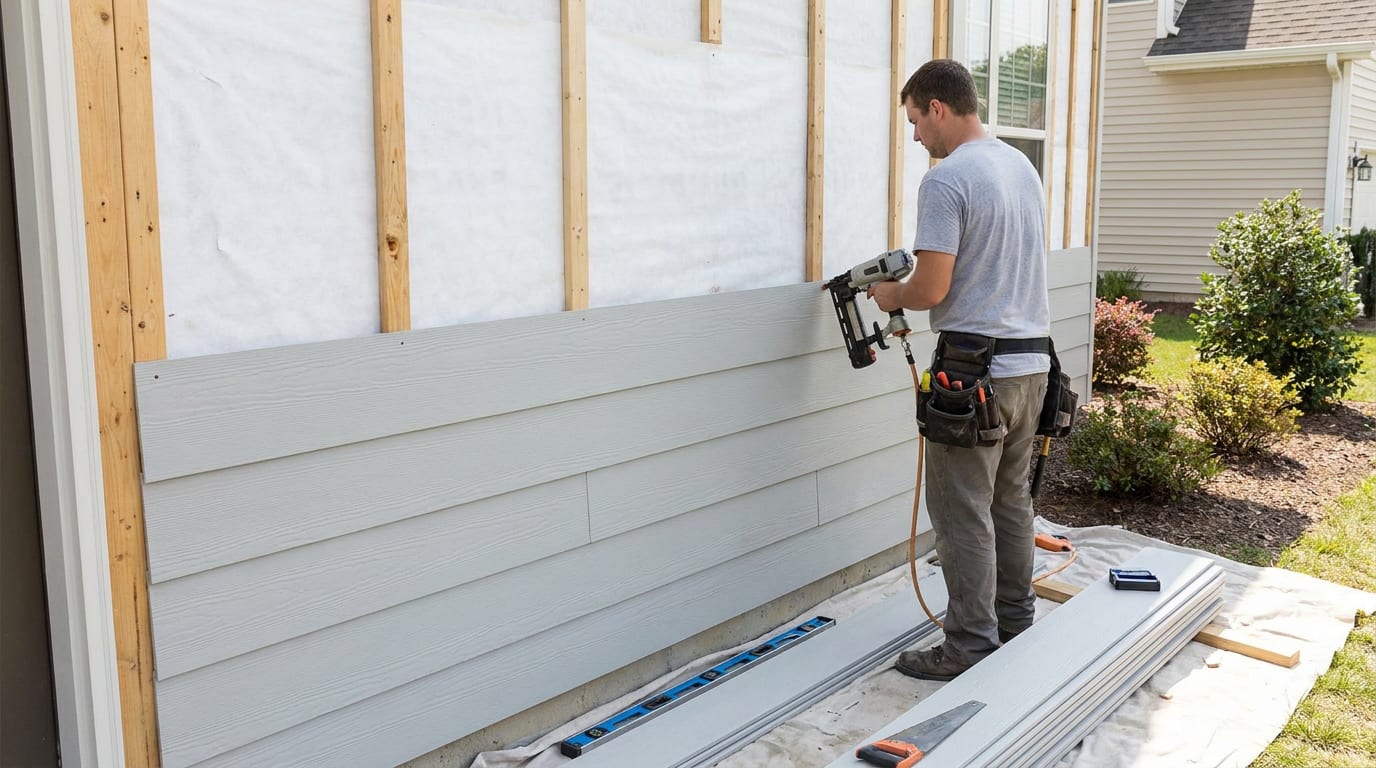
Vinyl must hang loose with the nail centered in the slot and not driven tight, or it buckles in Middle Tennessee heat. Fiber cement has a specified fastener pattern and edge distance that the warranty depends on.
Blind nailing versus face nailing on fiber cement changes both appearance and warranty status.
- Named weather-resistive barrier
- Sill pans and head flashing at every opening
- Kick-out flashing at roof-wall junctions
- Correct fastener type, pattern and edge distance
- Expansion gaps at trim and corners
What happens when rot is found
It will be found on most Nashville re-sides. A good contract names a per-sheet price for sheathing and a per-foot price for framing repair, agreed up front.
Without that, discovery becomes a negotiation midway through the job with the wall already open, which is the worst possible position to negotiate from.
Trim, caulk and the visible finish
Which trim material — PVC and composite do not rot, wood does. Where caulk goes and, more importantly, where it should not: siding butt joints on fiber cement are often better left with a joint flashing behind than caulked.
Ask to see a completed job three or four years old rather than a fresh one. New siding all looks good.
FAQ
The Siding Details That Decide Everything — questions
What is kick-out flashing and why does it matter?
It is a small piece of flashing where a roof edge meets a wall, and it diverts roof runoff away from the wall and into the gutter. Without it, water from a whole roof slope runs down behind the siding at one point. It is inexpensive, frequently omitted, and responsible for a disproportionate share of serious wall rot.
Should siding be caulked at the joints?
It depends on the product. Many fiber cement manufacturers specify joint flashing behind butt joints rather than caulk, because caulk fails and then traps water. Caulking is appropriate at trim intersections and penetrations. A contractor who caulks everything is not following the manufacturer instruction.
How do I compare two very different siding quotes?
Ask both to itemize the weather barrier, the flashing details at openings and roof junctions, the fastener method, and the agreed price for repairing rot if it is found. Those four items account for most of the difference, and they are the ones that decide whether the wall lasts.
What is behind the siding on a house?
A weather barrier, usually house wrap, over the wood sheathing and framing, with flashing at every window, door and roof-wall junction to steer water back out. Those layers keep the wall dry far more than the siding face does, which is why a good quote names the barrier, the sill pans, the head flashing and the kick-outs.